Abu Dawud (1609)
Two things stand out in this hadith. First, the Prophet (SAW) specifically mentions idle talk and indecent act, not just major sins, but the small slips of the tongue and behaviour that accumulate across a long month. Fitrana is the cleansing of all of that. Second, the timing in this hadith is not a suggestion. It is a condition. Pay before the Eid prayer, and it is Zakat. Pay after, and it loses that specific status entirely.
It Means Every Family Can Celebrate Eid
Eid al Fitr is supposed to be a day of joy for every single Muslim, not just those who can afford it. The Prophet (SAW) said to give Fitrana so that the poor are made free from having to beg on this day. That word — free — carries enormous weight. The goal is not just that people have food but the goal is that they have dignity. That they can join the Eid celebrations without shame, without hunger, without anxiety about how their children will feel.
You are giving a family the ability to wake up on Eid morning and share in the same joy you feel. That is a profound thing to be part of.
It Reminds Us That Our Blessings Are Never Ours Alone
Throughout the month of Ramadan, many of us experienced blessings that others around the world could only dream of, enough food for Suhoor and Iftar, the safety to fast in peace, a warm home to pray in. Fitrana is Islam's way of reminding us that the needy have a share in those blessings. The poor are not asking for charity. They are collecting what Allah has already designated as their right within the wealth of those who have enough.
This is the deeper meaning of Fitrana being described as a compulsory charity rather than a voluntary one. It is not generosity, it is justice.
It Binds the Ummah Together
There is a moment every year, in the last days of Ramadan, where something remarkable happens. Muslims in London, Lahore, Lagos, and Kuala Lumpur are all doing the same thing, working out how much Fitrana to pay for their household, making sure it reaches someone who needs it before Eid. There is no other act of worship quite like it. Giving Fitrana is not just an individual act. It is a collective one and one of the most tangible expressions of what the Muslim community actually means in practice.
Who is Eligible for Fitrana?
This question has two sides that are both important. Who is required to pay Fitrana, and who is eligible to receive it?
Who is Required to Pay Fitrana?
Fitrana is obligatory upon every Muslim, male or female, young or old who has enough food to meet their own needs and the needs of their household for the day and night of Eid. That is the only test. You do not need to calculate your savings or compare your wealth against a nisab threshold the way you would for annual Zakat. The question is simply: do you have enough food for yourself and your family for Eid day? If yes, you are required to pay.
The head of the household carries the responsibility for making the payment on behalf of every member of the family. This includes children of any age, even a baby born just before the Eid prayer counts, and Fitrana must be paid for that child too. It includes elderly parents living in your home. It includes any dependent who cannot make the payment themselves.
The only person who is genuinely exempt is someone who does not have enough food for their own household on Eid day. In that situation, not only are they not required to pay, they may actually be among those entitled to receive Fitrana from others.
Who is Eligible to Receive Fitrana?
Fitrana must be distributed to the poor and the needy. These are people who do not have enough food or financial means to celebrate Eid without outside help. Families in genuine hardship, orphaned children, widows without support, and people trapped in poverty are all among those who should receive Fitrana.
The key condition is real need. Fitrana is not meant for those who already have wealth. It is not meant to be given to your own children whose Fitrana you are already paying on their behalf. And it must reach the recipients before the Eid prayer, if it arrives after Eid is already over, it has failed its entire purpose.
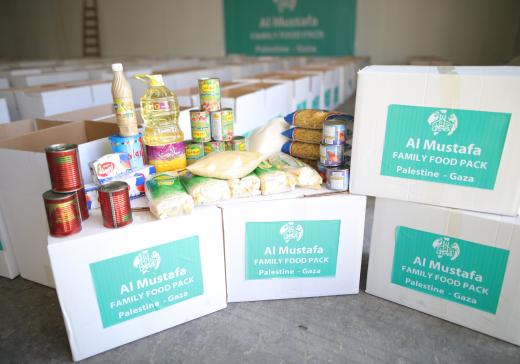
When you give your Fitrana to a charity like Al Mustafa Welfare Trust, the distribution process is handled within Islamic guidelines. Eligible families are identified, the payment reaches them on time, and your obligation is fulfilled correctly.
How to Calculate Fitrana 2026 — A Step-by-Step Guide
One of the most searched questions every Ramadan is simply: how much is Fitrana? The answer is both simple and rooted in a beautiful prophetic tradition.
The Prophet (SAW) set the Fitrana amount as one sa — also written as one saa, of staple food. The sa is an ancient Islamic unit of volumetric measure, and one saa is generally accepted to be approximately 2.5 to 3 kilograms of a staple food. Ibn Umar (RA) narrated in Sahih Bukhari that the Prophet (SAW) made Zakat ul Fitr obligatory as one sa of dates or one sa of barley upon every Muslim, slave or free, male or female, young or old.
In the modern world, most scholars agree that paying the monetary value of one saa of staple food is fully permissible and in many cases more beneficial, because it allows the charity to purchase exactly what the recipient needs rather than delivering a specific grain they may not use. The monetary value is calculated based on the price of the staple food locally, which is why the Fitrana amount varies slightly from country to country.
Here is how to calculate the correct amount for your household in 2026, step by step.
Step 1 — Confirm the rate for your country. In the UK, the Fitrana amount for 2026 is £5 per person. This is the minimum amount and has been confirmed by Islamic scholars and major UK charities based on current staple food prices. Always verify the current year's rate before paying, as it can change with food prices.
Step 2 — Count every person in your household. This means you, your spouse, every child, elderly dependents, and anyone else under your care whose Fitrana you are responsible for. Do not forget newborns. A baby born before the Eid prayer is included.
Step 3 — Multiply per person amount by total household members. The calculation is simple. If there are four people in your household, you pay four times the per person rate. At £5 per person, four people means a total payment of £20. A household of six would be £30. A single person living alone would pay £5.
Here are a few worked examples to make this completely clear: